

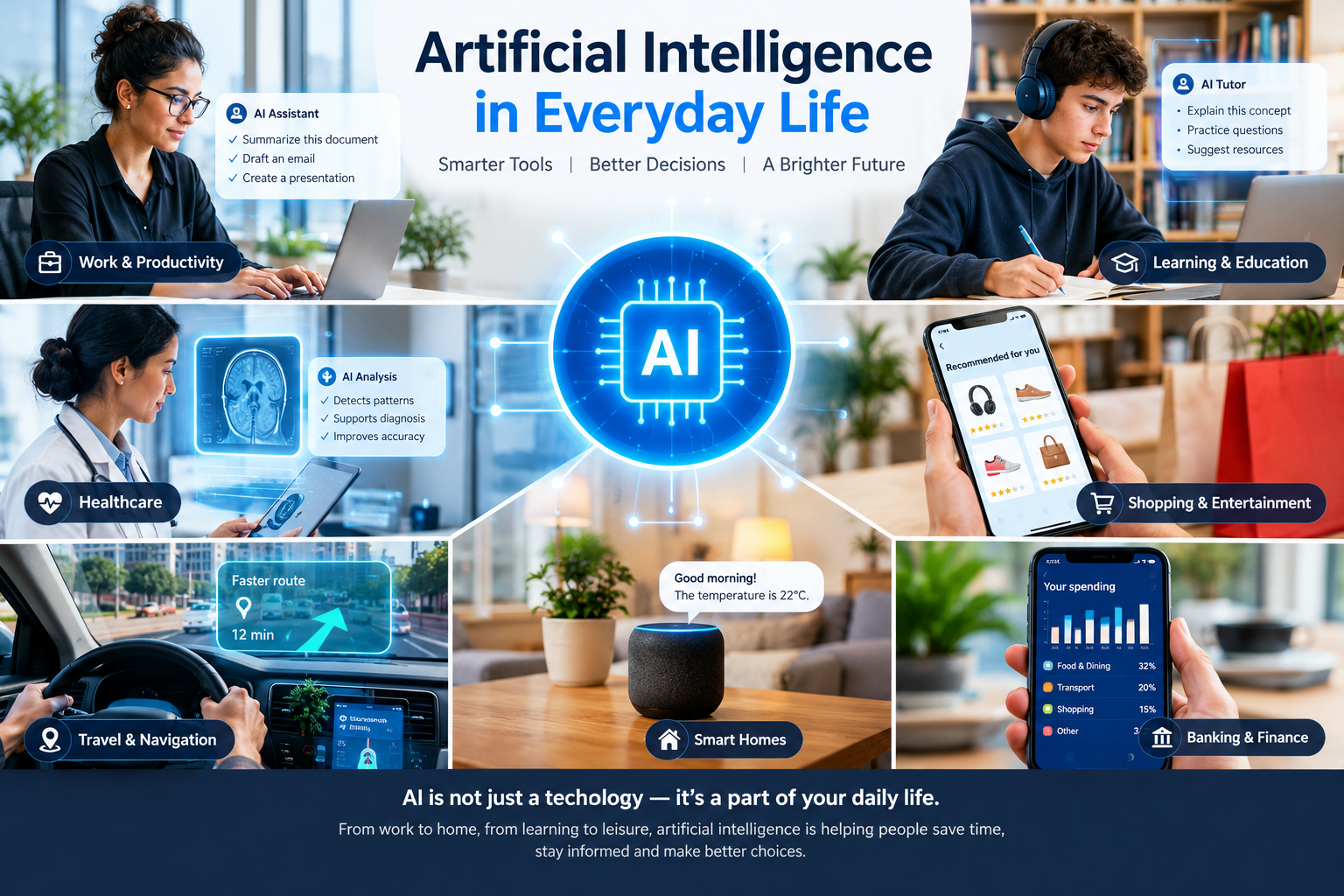
Artificial intelligence is becoming an increasingly important part of modern life. From the recommendations people receive while watching videos to the digital assistants that help them write, research, translate languages, and organise their schedules, AI technology is changing how people interact with the digital world. Explore Artificial Intelligence in Everyday Life: How AI Is Changing the Way We Work, Learn and Live.
What once seemed like a futuristic concept is now being used in homes, schools, hospitals, offices, shops, and businesses. Companies use artificial intelligence to analyse information, automate repetitive tasks, improve customer service, and identify patterns that may otherwise be difficult to recognise. Individuals use AI-powered applications to learn new skills, create content, and complete everyday activities more efficiently.
However, the growing use of AI also raises important questions about privacy, employment, accuracy, fairness, and the future of human decision-making.
Understanding artificial intelligence in everyday life is therefore about more than learning what the technology can do. It also means recognising its limitations, knowing when to trust its results, and understanding how to use it responsibly.
This article explores how AI works in practical terms, where it is being used, its potential benefits and risks, and what its development could mean for the future.
What Is Artificial Intelligence?
Artificial intelligence, commonly known as AI, refers to computer systems designed to perform tasks that typically require human-like capabilities, such as recognising patterns, understanding language, interpreting images, generating content, or making predictions from data.
AI is not a single technology. It includes several approaches, including machine learning, natural language processing, computer vision, and generative AI.
Machine learning enables computer systems to identify patterns in data and use them to make predictions or classifications. Natural language processing helps computers work with human language, while computer vision allows systems to analyse photographs, videos, and other visual information.
Generative AI is a category of technology capable of producing new content, including text, images, audio, video, and computer code, in response to instructions or prompts.
These technologies power many of the applications people encounter every day. Email spam filters, navigation tools, translation applications, recommendation systems, voice assistants, and AI writing tools can all use artificial intelligence in different ways.
Although AI can perform increasingly sophisticated tasks, it does not automatically possess human understanding, judgement, or common sense. Its results depend on its design, training, available information, and the context in which it is used.
How Artificial Intelligence Is Used in Everyday Life
Many people interact with artificial intelligence without necessarily recognising it. AI-powered features are increasingly built into familiar digital products and services.
1. AI in Smartphones and Digital Assistants
Smartphones provide one of the most accessible examples of artificial intelligence in everyday life.
AI-powered features can help users organise photographs, improve image quality, dictate messages, translate conversations, filter unwanted calls, and interact with voice assistants. Some devices also use AI to predict text, recognise speech, and make applications more responsive to individual needs.
These features can save time and make digital tools easier to use. Translation and speech-recognition technologies may also help people communicate across language barriers or access information in more convenient ways.
However, users should review the privacy settings of their devices and understand what information an application collects, stores, or shares.
2. AI in Online Shopping and Entertainment
Online retailers, streaming services, and social platforms often use recommendation systems to suggest products, films, music, videos, and other content.
These systems analyse patterns in user activity, which may include previous interactions, viewing history, product searches, or stated preferences. They then estimate which items might be relevant to a particular user.
For shoppers, recommendations can make it easier to discover products. For entertainment audiences, they can help surface content that matches their interests.
There are limitations, however. Recommendations may repeatedly present similar material, prioritise commercial objectives, or reinforce existing preferences. Users can benefit from exploring content beyond automated suggestions rather than relying entirely on algorithmic recommendations.
3. AI in Navigation and Transportation
Navigation applications can use machine learning and real-time information to estimate travel times, identify congestion, and suggest alternative routes.
Depending on the service, these systems may consider road conditions, historical traffic patterns, reported incidents, and information from connected devices.
Artificial intelligence is also used in research and development involving driver-assistance systems, traffic management, and autonomous vehicles.
These applications can support more informed travel decisions, but their predictions are not always correct. Drivers must continue to follow road rules, observe their surroundings, and avoid treating automated navigation instructions as infallible.
4. AI in Banking and Personal Finance
Financial institutions use AI-related technologies for activities such as detecting potentially fraudulent transactions, assessing patterns in financial data, supporting customer service, and identifying unusual account activity.
For example, a bank may flag a transaction that differs significantly from a customer’s normal spending patterns. Automated systems can help review large volumes of activity quickly, although additional checks may be necessary to determine whether a transaction is genuinely fraudulent.
Consumers can also encounter AI-powered budgeting applications and tools that categorise expenses or summarise financial information.
These technologies can be useful, but financial decisions require care. AI-generated investment predictions and financial recommendations can be inaccurate, incomplete, or based on assumptions that do not fit an individual’s circumstances.
Users should verify important information and avoid sharing banking credentials or sensitive financial details with untrusted applications.
How Artificial Intelligence Is Transforming Businesses
Businesses across different industries are exploring AI to improve productivity, understand customers, and manage routine operations.
AI for Customer Service
AI-powered chatbots and virtual assistants can answer common questions, provide basic troubleshooting guidance, and direct customers to relevant information.
For businesses, these systems may reduce waiting times and help customer support teams manage repetitive enquiries. More complex situations still benefit from human judgement, particularly when they involve complaints, sensitive information, or unusual circumstances.
The most effective customer service systems use automation where appropriate while providing a clear route to human assistance.
AI in Marketing and Search Engine Optimisation
Digital marketing is another area experiencing significant change.
Marketing teams can use AI tools to brainstorm content ideas, analyse search trends, organise keyword research, summarise customer feedback, and develop initial drafts of marketing materials. Some platforms also use machine learning to support advertising optimisation and audience analysis.
For search engine optimisation, AI can assist with tasks such as identifying content gaps, grouping related search queries, analysing competing pages, and organising information into useful topic clusters.
However, AI-generated content alone does not guarantee better search rankings. Search visibility depends on multiple factors, including usefulness, originality, relevance, site quality, accessibility, and the extent to which a page satisfies the reader’s needs.
Businesses should use AI to support research and production rather than publish large volumes of repetitive, unverified material. Human expertise, fact-checking, first-hand experience, and editorial judgement remain important.
AI in Small Businesses and Entrepreneurship
Small businesses can use accessible AI tools to support everyday operations without necessarily building their own machine-learning systems.
Possible applications include drafting customer emails, summarising documents, preparing meeting notes, generating design concepts, translating basic communications, and organising internal information.
For entrepreneurs, these tools can make certain tasks faster and help small teams experiment with ideas that might otherwise require additional resources.
Nevertheless, business owners should assess the cost, reliability, security, and practical value of each tool before adopting it. AI-generated material should be checked for accuracy, and confidential business information should not be entered into services without understanding their data-handling policies.
The Role of AI in Education and Learning
Artificial intelligence is creating new possibilities for students, teachers, and lifelong learners.
AI-enabled learning tools can explain difficult concepts, generate practice questions, provide language exercises, and adapt learning activities to different levels of knowledge. Students can use them to explore subjects, compare explanations, and identify areas where they need further study.
For teachers, AI may assist with preparing lesson materials, developing examples, or creating alternative explanations of complex topics.
The value of these tools depends on how they are used. An AI assistant can provide an incorrect answer confidently, misunderstand a question, or present a simplified explanation that misses important details.
Students should therefore treat AI as a learning aid rather than a substitute for independent thinking. Checking information against textbooks, academic sources, and teachers’ guidance helps develop stronger research and reasoning skills.
Educational institutions also need clear policies explaining acceptable AI use, academic integrity, privacy, and the distinction between assistance and submitting work that does not reflect a student’s own effort.
How Artificial Intelligence Is Supporting Healthcare
Healthcare is an important area of AI research and application. Depending on the system and its intended use, AI can assist healthcare professionals with medical image analysis, administrative work, clinical documentation, research, and the identification of patterns in patient data.
Some systems are designed to help specialists examine scans or prioritise cases for further review. Others support the analysis of large datasets used in medical research and drug development.
AI may also help reduce certain administrative burdens, allowing healthcare staff to spend more time on patient care.
However, medical applications require particularly careful evaluation. A system may perform well in one setting but less reliably with different populations, equipment, or clinical conditions. Data quality, bias, security, and professional oversight are significant concerns.
AI tools should not replace qualified medical professionals or be treated as definitive sources of diagnosis. Anyone experiencing worrying symptoms or needing medical advice should seek appropriate healthcare support.
The Benefits of Artificial Intelligence
When developed and applied responsibly, AI can offer several practical benefits.
Greater Productivity and Efficiency
AI can automate certain repetitive tasks, process information quickly, and help people organise their work. This can allow individuals and teams to devote more time to activities requiring creativity, communication, and judgement.
Improved Access to Information
Language tools, summarisation systems, and conversational assistants can help users explore unfamiliar subjects and locate relevant information more easily. Their outputs still need verification, particularly when accuracy is essential.
Support for Accessibility
Speech recognition, text-to-speech, automatic captioning, image descriptions, and translation tools can help some people access digital information in ways that better suit their needs.
The effectiveness of these features varies, and they should be designed and tested with different users in mind.
Assistance With Research and Problem-Solving
AI can help researchers and professionals identify patterns, organise large amounts of information, generate hypotheses, and explore possible solutions. Its contribution is most valuable when combined with appropriate expertise and independent validation.
New Opportunities for Innovation
AI can support experimentation in areas such as software development, product design, scientific research, creative production, and business planning. It can make some forms of experimentation more accessible, although high-quality results may still require specialist knowledge and resources.
The Risks and Challenges of Artificial Intelligence
The benefits of AI must be considered alongside its limitations and potential harms.
Inaccurate Information and AI Hallucinations
Generative AI systems can produce information that sounds convincing but is incorrect. They may invent sources, misunderstand context, misstate statistics, or provide outdated details.
This is especially important in news reporting, health, finance, law, and other areas where inaccurate information can have serious consequences.
Users should verify important claims against reliable primary sources and avoid treating fluent writing as proof of factual accuracy.
Privacy and Data Security
AI applications may process personal information, documents, photographs, voice recordings, or business data.
Before using a tool, people should understand its privacy policy, data-retention practices, and available controls. Sensitive personal, financial, medical, or confidential business information should not be shared unless the service is appropriate for that purpose and the relevant safeguards are understood.
Organisations also need suitable access controls, staff training, and procedures for handling information securely.
Bias and Unfair Outcomes
AI systems can reflect weaknesses in their training data, design, or evaluation methods. As a result, their performance may differ between groups or produce unfair outcomes in certain situations.
This is particularly concerning when AI influences recruitment, lending, education, healthcare, or access to services.
Responsible deployment requires testing, monitoring, meaningful human oversight, and processes for challenging decisions where appropriate.
Employment and Changing Skills
Automation may change how work is organised. Some routine tasks may require less manual effort, while other roles may evolve or demand new technical and analytical skills.
The effects will vary by occupation, industry, organisation, and location. It is more useful to examine how specific tasks are changing than to assume that every job will disappear or remain unaffected.
Workers and employers can prepare by developing digital literacy, communication, critical thinking, and the ability to evaluate AI-generated information.
Misinformation and Deepfakes
AI tools can generate convincing images, audio, and video, including fabricated representations of real people. Such material can be used creatively, but it can also facilitate scams, impersonation, harassment, and misinformation.
Readers should be cautious with sensational content, verify important claims through independent sources, and consider the original context of media before sharing it.
How to Use AI Responsibly in Everyday Life
People do not need to be technical experts to use AI more thoughtfully. A few practical habits can make a meaningful difference.
- Check important facts. Verify significant claims using trustworthy sources, especially for medical, financial, legal, and news-related information.
- Protect personal information. Avoid entering sensitive data into unfamiliar tools, and review privacy settings before use.
- Use your own judgement. Treat AI responses as assistance, not automatic instructions or final decisions.
- Be transparent when necessary. Follow applicable rules and explain the use of AI when disclosure is required or important to readers, customers, or colleagues.
- Review generated content. Check for errors, misleading statements, bias, inappropriate language, and missing context before publishing or relying on an output.
- Keep learning. AI tools change rapidly, so users should understand both the capabilities and limitations of the systems they choose.
These practices can help individuals and organisations gain value from AI while reducing avoidable risks.
What Does the Future of Artificial Intelligence Look Like?
The future of AI will depend on advances in research, public policy, business decisions, user expectations, and the safeguards developed around these systems.
AI applications may become more integrated into workplace software, personal devices, educational resources, research platforms, and customer services. Systems that can work with different forms of information, including text, images, audio, and video, may create new possibilities for communication and automation.
At the same time, important challenges will remain. Organisations will need to consider reliability, energy use, data protection, accountability, accessibility, and the impact of automation on workers and communities.
The future is unlikely to be determined by technology alone. The choices made by developers, governments, employers, educators, and users will influence which applications are adopted and how their benefits and risks are distributed.
Rather than viewing AI as either a universal solution or an inevitable threat, a balanced approach recognises that its effects depend on the purpose, context, design, and oversight of each application.
Conclusion: Artificial Intelligence Is a Tool, Not a Substitute for Human Judgement
Artificial intelligence is already influencing how people communicate, learn, shop, travel, work, and access information. Its applications can improve efficiency, support accessibility, assist research, and create new opportunities for individuals and organisations.
However, AI also introduces challenges involving accuracy, privacy, bias, employment, and the spread of misleading content. Understanding these issues is essential to making informed decisions about when and how to use the technology.
For individuals, the most practical approach is to explore useful applications while checking important information and protecting personal data. For businesses, responsible adoption means connecting AI tools to clear objectives, evaluating their performance, and maintaining appropriate human oversight.
As artificial intelligence continues to develop, digital literacy and critical thinking will become increasingly valuable. The goal should not simply be to use more AI, but to use it thoughtfully, effectively, and in ways that serve people.
Frequently Asked Questions About Artificial Intelligence
What is artificial intelligence in everyday life?
Artificial intelligence in everyday life refers to AI-powered features and services used in activities such as navigation, online shopping, entertainment, communication, banking, education, and work. Examples include recommendation systems, voice assistants, spam filters, translation tools, and generative AI applications.
What are the main benefits of artificial intelligence?
Potential benefits include increased productivity, faster information processing, improved accessibility, support for research, and assistance with repetitive tasks. The actual benefits depend on the quality of the system and how it is used.
Can artificial intelligence make mistakes?
Yes. AI systems can misunderstand questions, produce inaccurate information, reflect bias, or generate fabricated details. Important outputs should be checked against reliable sources, especially in high-stakes situations.
How is AI changing the workplace?
AI can automate certain tasks, support research and communication, and change the skills required for some jobs. Its effects differ across industries and occupations, making ongoing learning and adaptation important.
Is artificial intelligence safe to use?
AI can be useful, but safety depends on the application, the information shared with it, and the decisions made using its outputs. Users should protect sensitive information, verify important claims, and maintain human oversight where necessary.
How can beginners start learning about AI?
Beginners can start by learning basic AI concepts, trying reputable tools with non-sensitive tasks, comparing AI answers with reliable sources, and exploring introductory educational resources. Understanding the limitations of AI is just as important as learning its features.